Protected Area
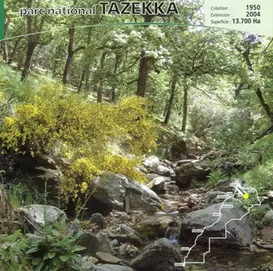
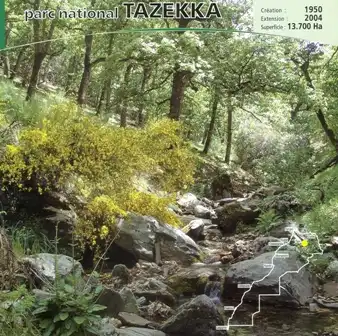
Tazzeka National Park
The Tazekka National Park (PNTZ), created in 1950 on an area of 11,000 ha, is located in the northernmost part of the Middle Atlas, near the city of Taza (34°06'N-04°11'W).
This is a mountainous park extending between 1400m and 1980 m (the summit of Tazekka), created in order to preserve the cedar grove of Jbel Tazekka, very isolated and witness to the ancient extension of cedar groves in Morocco, the Tazekka Park only covers an area of 680 ha.
The dynamics endogenous to the forest ecosystem generally require areas of the order of a thousand hectares to be expressed correctly, the functional ecological unit then being established from the limits of these areas. In the case of PNTZ, the illustration of this principle appears very clearly with the natural extension of the cedar forest on the northern and eastern slopes of the massif, the young cedars being outside the current boundaries of the Park.
It was therefore logical to completely rethink the layout of this Park, boundaries and zoning. To this end, the forest services proposed an extension of the Park up to a total area of 12,700 ha, taking place around three key areas: a central core of 2500 ha, a suberaie area (Bab-Azhar: 6000 ha), and a so-called “tourist” area including the Chiker forest (green oak forest), the Dayat Chiker, the Friouato chasm, the Bab-bou-bou-site. Idir, the site of Ras-el-Maa, and Sidi-Mejbar.
The study carried out therefore naturally focuses on this expanded space, with the aim of deepening this proposal on the basis of biological, ecological and socio-economic investigations.
The nature of the substrate (limestone in the east, siliceous in the west) and the altitude are the factors of the environment determining the vegetation of this set:
To the east, an unmanaged oak forest, interspersed with dry crops and bordered by an intensive cereal dayat (dayat Chiker) in the west, a managed cork oak forest, of high economic importance, both for its cork production and for its pastoral production> in the center, a relatively high massif, the Tazekka, covered by a summit cedar forest, and associations plants more varied than in the previous areas (zene oak, holm oak, cork oak, mixed populations). The cedar forest has been protected since 1950.
The PNTZ is not home to as many remarkable species as other Moroccan national parks (e.g. PN Souss-Massa: bald ibises, PN Al-Hoceima: ospreys), although the observation of vultures and salamanders is possible there. Its assets lie mainly in its isolated cedar forest, its forest areas, its varied landscapes and its chasms, its panoramas. It should be noted that in the field of biodiversity, the forthcoming reintroduction of Berber deer should give it a new dimension.
Its ecological role is vital, the Tazekka being the main supplier of natural water for an entire region located downstream. Its socio-recreational role is also important in summer. Its economic role lies in the products and by-products offered by the forest such as firewood, cork and fodder units.
The PNTZ is not (for the moment) undergoing any worrying deterioration, except perhaps the eastern slope of Tazekka and the surroundings of Dayat Chiker, which are overgrazed. The restricted park sheltering the Tazekka cedar grove is well respected by the local populations, it is almost the same with the entire forest area of this region.
But this optimistic observation must however be tempered by the degradation that the cave heritage is undergoing, in particular the famous Friouato chasm.
Published on
2020 Oct 23Countries

Morocco