Document
Document
Published on
2022 Feb 08Countries

Morocco
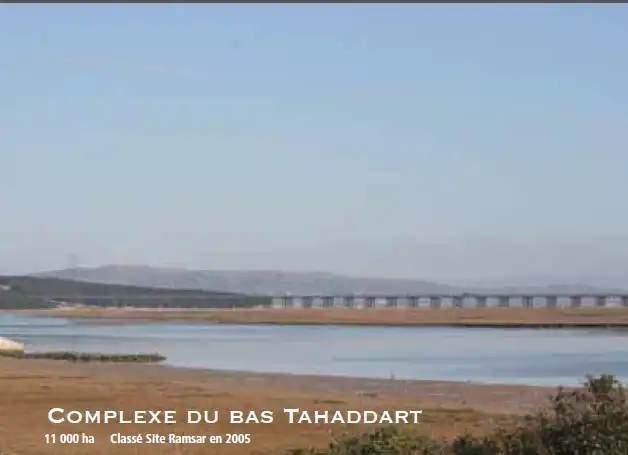
Lower Tahaddart Complex (L21)
It is a Ramsar wetland. This is the 11000 ha complex of wetlands on the Atlantic side of the Tingitan Peninsula (estuarine zone, coastal waters and associated beach, alluvial plains, dam reservoirs, salt lakes, temporary, temporary salt lakes, temporary, temporary freshwater pools). This complex is fed by the tide and precipitation and its hydrology has been affected by the reservoirs of the Iben Battouta and Al Hachef dams. The alluvial plain is an important grazing area.
The greatest hydrological value is to allow the recharge of the local groundwater table, whose emergences normally allowed the maintenance of patches of freshwater habitats. Two species of flora are very rare in Morocco (Puccinellia distans endemic to Morocco and Spartina maritima), one species is rare (Limoniastrum monopetalum) and two others are vulnerable (Ruppia maritima and Sarcocornia perennis).
The site is regularly frequented by the Great Bustard Otis tarda; its population sometimes corresponds to half of the local population.
- Coordinates: 35°34' N - 6° W.
- Map references: 1/50,000 - EL MANZLA.
- Administrative province: TANGER.
- Close administrative center: Asilah.
- Forest district: Charf el Akab.
- Biogeographic region: No. 2 - RHARB Nord.
- Area: 14,000 ha.
- Land system: Domanial and private; Khalifian titles.
- Uses: agriculture - pastoralism - fishing and hunting - salt flats.
- Bioclimatic characteristics: Thermomediteranean sub-humid with warm winters.
Physical characteristics:
- Rectilinear, sandy coast, with beaches and lively dunes interrupted permanently at the level of the estuaries.
- Oued Rharifa:
- Oued Tahadart:
- Alluvial plains
- El Meros area
- Hinterland made up of hills and low plateaus.
Flora:
- Vast Sansouires at Salicornes and Suaeda in the mouths and plains.
- Suberaie on the hills and plateaus; non-spontaneous Acacia reforestation (Tahadart mouth).
- Fauna
- Fish and a very modest oyster (Crassostrea angulata) deposit in the mouth.
- Mudflats and Sansouires with a rich and diverse invertebrate population.
- Unknown herpetofauna, but probably rich and interesting. Endemics of the Moroccan ocean coast, Tingitan elements and Rifan endemics could coexist there, to which should be added the classic Mediterranean species in Morocco.
Avifauna:
- The area is home to the last population of Great Bustard in Morocco (another 50 recorded in December 1993), and therefore of the entire African continent.
- Winter residence of large concentrations of Waterbirds: several hundreds of Common Cranes (up to 600), Pink Flamingos and Avocets, several thousand Shorebirds (especially Sandpipers, Barges and Plovers) and Anseriformes (Butterflies, Plovers) and Anseriformes (Greylag Goose, Common Shelduck, Surface Ducks). Laridae bands are also important there (rest, toilet).
- A very important stopover on the routes of Palearctic migratory birds when the area is in water: Pink Flamingo, Spoonbill, Anatidae (including Summer Teal) and Shorebirds, Pygmy Gull and Terns.
- Reproduction of Collared Glareola, Dwarf Tern, Collared Chopper Interrupted Oedicnème and, possibly, Stilt and Avocet. The Spoonbill tried to reproduce there about twenty years ago (13 nests, destroyed by local residents).
Ecosystems and environments:
- Wadi mouths and cultivated areas with a very important ecological role for avifauna.
Published on
2022 Feb 08Countries
Morocco