Document
Document
File Name
Stratégie Nationale 2015-2024 pour les Zones Humides du Maroc.pdfFile Type
PDF DocumentFile Size
1.66 MBCreated Date
2022 Jan 12Updated Date
2022 Jan 12Published on
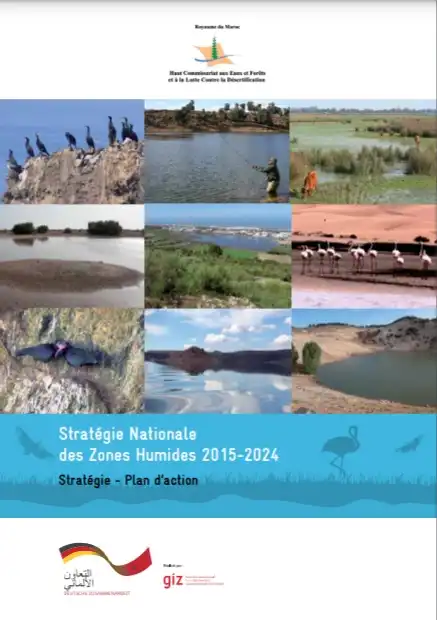
2022 Jan 12National Wetlands Strategy
The purpose of the National Wetlands Strategy is to establish mechanisms and processes that can ensure the sustainable use of Morocco's wetlands, in the sense that they guarantee both the conservation of their heritage values, especially ecological ones, and their ecosystem services.
This is based on the identification and justification of the major issues that mark the past and current uses of wetlands and whose negative effects justify the need for these mechanisms. These challenges were defined in a diagnostic document (Dakki & Menioui 2014), following a brief presentation of the basic concepts and principles to which this Strategy refers and of the distinctive characteristics of Moroccan wetlands, their main heritage values and the services they provide to populations.
The vision of this strategy is “In 2024, Moroccan wetlands are managed in an integrated and sustainable manner, ensuring the improvement of their ecological heritage and their ecosystem services”.
The national wetlands strategy includes five main axes (or global objectives), developed into 17 strategic (specific) objectives, formulated for all the axes based on the analysis of wetland conservation needs.
Axis 1: Improving the heritage values and ecological functions of wetlands;
- Objective 1.1: By 2024, significantly improve the conservation status of natural wetland habitats.
- Objective 1.2: By 2024, establish and implement national plans for the rehabilitation and sustainable management of the heritage fauna and flora of wetlands.
Axis 2: Promote the sustainable economic valorization of wetland ecosystem services
- Objective 2.1: Promote the integration of actions to enhance the value of wetland ecosystem services into management plans
- Objective 2.2: Promote plans for the valorization of wetlands, in particular those classified on the Ramsar List, through ecological tourism.
- Objective 2.3: Promote green jobs and local know-how developed in connection with wetlands.
Axis 3: Improving governance and coordination mechanisms between public policies affecting wetlands
- Objective 3.1: By 2024, strengthen the system implemented by the Ramsar Focal Point for wetland management.
- Objective 3.2: By 2024, incorporate sustainable wetland management goals into sectoral and local government policies and procedures.
Axis 4: Develop knowledge about wetlands and the mechanisms for sharing them
- Objective 4.1: By 2024, provide land and resource management sectors with the knowledge and know-how necessary for the rational use of wetlands.
- Objective 4.2: By 2024, provide the country with a national mechanism for developing and sharing information on wetlands.
- Objective 4.3: Formally integrate wetlands into engineering, social and natural sciences courses.
- Objective 4.4: Promote the development of regional training and research structures.
- Objective 4.5: Promote training in nature protection for the benefit of actors in the management of wetlands and space in general.
Axis 5: Develop the Communication, Education, Awareness and Participation (CESP) system for the conservation of wetlands
- Objective 5.1: Establish CESP instruments adapted to different target audiences.
- Objective 5.2: Strengthen the network of information centers at the level of Ramsar Sites.
- Objective 5.3: Develop the public-NGO partnership around the CESP in favor of wetlands.
- Objective 5.4: Develop public-private partnerships (PPP) in favor of wetlands.
- Objective 5.5: Develop the City Label (Ramsar Label) for wetlands.
The Strategy has been developed into an action plan whose feasibility is assessed above all according to the predisposition (or conviction) of the actors to implement the actions that fall within their missions, but also on the mass of resources that they must mobilize or the constraints that these actions are supposed to generate for them. For some actors other than the Department of Water and Forests and the Department of the Environment, some actions provided for in this Strategy aim to guarantee their commitment; however, the action plan is focused on actions whose chances of implementation appear to be high.
The 17 objectives are translated into 60 priority actions designed and formulated in direct consultation with PF Ramsar and with other actors involved in the management of space and natural resources.