Ecosystem
Ecosystem
Published on
2020 Oct 21Acaciaries
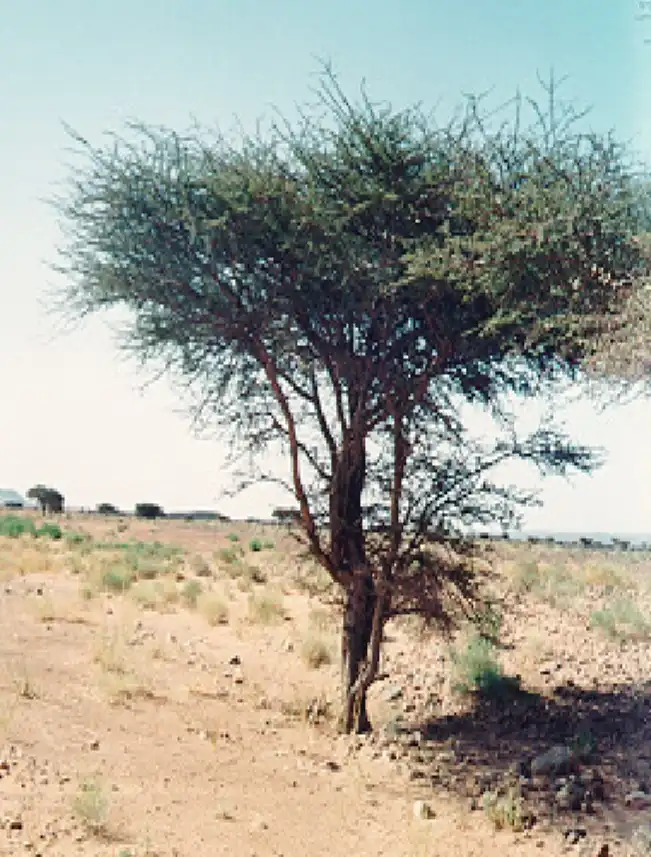
The Acacia genus is represented in Morocco essentially by 3 species: Acacia gummifera (Moroccan gum tree), A. ehrenbergiana and A. raddiana, occupying a total area of 1,000,000 ha. These species can organize pre-steppe or even pre-forest climaxes, in the most disadvantaged regions of the country in arid and Saharan bioclimates.
Together with the argan tree, the Moroccan gum tree contributes to the definition of the Moroccan Macaronesian sector. These two species are often mixed, but the gum tree grows further inland in arid cisatlasic Morocco (dir of the High Atlas, Tadla, Haouz and Rehamna). Its populations are often found in a mixture with xerophilic and thermophilic species, including: Withania frutescens, Ballota hirsuta, Asparagus stipularis, Ephedra altissima, La vandula multifida, etc. The sulphur gum tree from the attacks of a fearsome depredator: the Cerambycid Coleoptera Hypoeschrus strigosus, whose larvae attack in the woods, staying there for more than two years before pupating.
Acacia ehrenbergiana and A. raddiana are trees or shrubs that are fairly common throughout the Sahara where they are “loved” by residents for the shade they offer under a hot sun in the middle of lunar landscapes.
The very slow growth of these acacias and the anthropozoogenic pressure they are subjected to mean that their areas, currently estimated at one million ha, are constantly decreasing. The area of A. ehrenbergiana is limited to the North by the Jbel Bani, that of A. raddiana goes up to the vicinity of Tazenakht, and further east to the southern slopes of the Saghro and Ougnat.
In acacias, in Saharan and pre-Saharan climates, more than 130 species of Arthropods have been recorded, which have found a good shelter in the shade of their foliage in these torrid areas. From an ornithological point of view, two species are very characteristic of these populations: the Tawny Crater (Tu rdoides fulvus) and the southern shrike (Lanius meridionalis); in addition, many species of insectivorous passerines (Sylviidae, Muscicapidae, Laniidae) stop there.