Document
Document
Published on
2022 Feb 09Countries

Morocco
Mohamed V dam (H2)
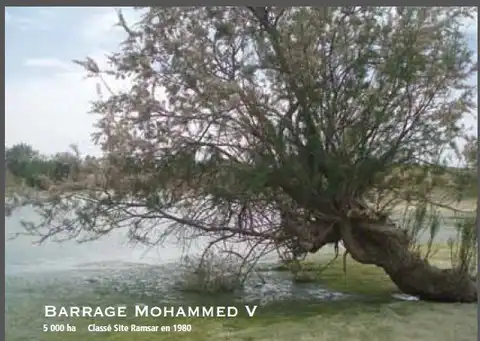
Large dam lake on the Moulouya river occupying an arid and open valley, marked by numerous ravines, where the lake takes on a branched appearance. The slopes are covered by sparse steppe vegetation, with some eucalyptus plantations on the slopes. This site is located at an altitude of 218 m and was flooded in 1967, its maximum depth was 60 m and was gradually reduced due to siltation.
As a dam, this site plays a fundamental role in controlling the floods, which devastated the coastal plain in the Saidia region. The site is home to a beautiful tamarica grove and islands of land that constitute areas suitable for the reproduction of waterbirds. Some twenty species summer in the site with respectable numbers (700-800 shelternes casarca, 130 crested grebes, 80 Hansel terns, more than 400 avocets and, above all, more than 4,000 common coots). Most of these summer residents breed regularly on the site.
SIBE data sheet
- Coordinates: 34° 41'N - 02° 57'W.
- Card references: 1/100,000 - AL YOUN.
- Administrative province: TAZA - BERKANE - NADOR.
- Close administrative center: Tawrirt.
- Forest District: Tawrirt/Saka/Nador
- Biogeographical region: n°19 - EASTERN MOROCCO
- Area: 6,000 -6,500 ha.
- Land system: Public domain.
- Uses: Production of irrigation water and drinking water, electricity; fishing.
- Bioclimatic characteristics: Arid thermometerranean to temperate winters.
Physical characteristics:
It is one of the largest dams (5000 ha) in Morocco and the oldest (1967), fed almost exclusively by the Moulouya, although it receives several temporary streams. The dike is at the level of gorges, while the lake occupies a very open valley. Its initial depth is close to 60 m. The edge of the lake is very sinuous, due to the existence of a number of ravines that lead to it. The hills separating these ravines allow for panoramic views of the lake. The slopes are bare or covered by steppe vegetation, except upstream, where eucalyptus plantations cover large areas near the edge. Siltation is a fairly crucial problem (about 10 million m3/year), as the lake's watershed is almost that of the entire Malouya network. The waters are relatively warm (12-30 near the edges), often turbid and agitated on the surface, well mineralized and their pH varies between 7 and 8.
Flora:
Flora poorly represented at the time of the visit, not sampled, but Tamarix are abundant on the borders, at least along the right bank; sometimes in continuous shrub formation.
Wildlife:
Barbels, shad, and eels made up most of the native fish population, but at least three other species were introduced: Black-bass, Rotengle, and Zander, the latter being relatively abundant, as were the cornflowers. However, it should be noted that even if fishing is open, this activity is not very important in the site, given its proximity to sea ports (an amodiation has just been attributed which should regularly re-fish with carp).
It is especially the birds that are the main interest of this lake; they fully meet the criteria necessary for inclusion in the list of the RAMSAR Convention; greater protection and more in-depth studies could further strengthen these criteria.
Summer residents are still poorly known and the results presented here are those of June 1994. Twenty species have been observed and the figures recorded are very surprising, including 700-800 shelterns, 150 mallards, 130 crested grebes, 80 Hansel terns, more than 400 avocets and, above all, some 4200 common coots. Signs of nesting are obvious for all of these species except Avocet.
Other summer residents have been noted in low numbers: Stilt, Grey Grebe, Grey Grebe, Dwarf Tern, Chestnut-collared Chuck, Little Rock Egret, Little Egret, Grey Herons and Purple Herons... All are presumably breeding.
During the winter season, due to its large size and the difficulties of access to its north-western shore, this reservoir was the subject of only seven censuses, sometimes partial, during the last 12 years. They revealed about thirty species, a wealth that seems to us to be underestimated.
The highest total number is only 2,700 birds, with 1,400 ducks including Tigernut and scuba divers (Milouin and Morillon) reaching numbers of 500 individuals respectively. The other surface ducks (7 species including the Belon's Shelf) were only reported in low numbers (<60). The Common Coot, although regular and very abundant in nesting, probably does not exceed a thousand in wintering.
Laridae seem to rarely frequent this lake (300 black-headed gulls at most). Among the Piscivorous birds, note the absence of terns, while the Great Cormorant and the Great Crested Grebe are not abundant (20-30 ind. at most); however, the Osprey can be seen in large numbers (up to 11).
The shallow waters near the banks are frequented by pink flamingos (200, observable until early summer) and gray herons (50), even cranes (up to 480), while shorebirds seem very rare.
Ecosystems and environments:
Interesting habitats for feeding and/or nesting waterbirds:
- Islets near the right bank constituting isolated nesting sites for several species of waterbirds; the corresponding building at Dar Moul El Bacha should be considered in this context.
- Tamariçaie more or less dense on the edges, especially at the level of the ravines.
- Mudflats, sandpits and gravels, exempt when withdrawing from the shore.
Published on
2022 Feb 09Countries
Morocco