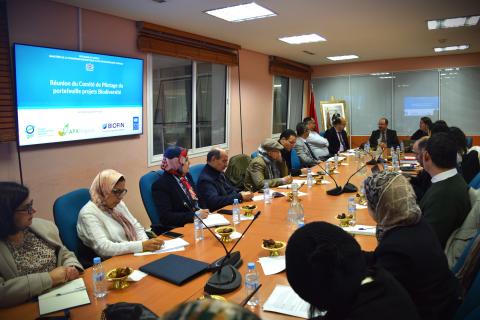
Steering Committee Meeting of the Biodiversity Project Portfolio: setting the course for 2026 towards the operationalization of the Global Biodiversity Framework in Morocco
Within the framework of the national governance mechanism for the Biodiversity project portfolio financed by the Global Environment Facility (GEF), and aimed at supporting the implementation of the Kunming–Montreal Global Biodiversity Framework, the Steering Committee (SC) met on Friday, 23 January 2026, at the headquarters of the Department of Sustainable Development, with the support of the United Nations Development Programme (UNDP).
This meeting focused on the monitoring and strategic guidance of three flagship projects for biodiversity in Morocco:
-
the Nagoya II ABS Project, related to access to genetic resources and the fair and equitable sharing of benefits;
-
the NBSAP / 7th National Biodiversity Report Project, aimed at aligning the national strategy with the Global Biodiversity Framework;
-
the BIOFIN Project, dedicated to the development of a national biodiversity finance plan.
Strengthened governance and enhanced strategic coordination
In his opening remarks, the Secretary General of the Department of Sustainable Development underscored the importance of this meeting within the governance framework of the Biodiversity portfolio, highlighting the prior consultation ensured by the National Biodiversity Sub-Commission. This approach guarantees the consistency of Annual Work Plans with national priorities and strengthens synergies among projects and partners, with a view to maximizing the impact of on-the-ground interventions.
For her part, the Deputy Resident Representative of UNDP in Morocco commended the strong mobilization of stakeholders and reiterated UNDP’s continued commitment—together with GEF support—to the implementation of the Global Biodiversity Framework. She notably highlighted the results of the Biodiversity Expenditure Review (2019–2024), which estimates national annual biodiversity-related expenditures at MAD 2.06 billion, representing 0.16% of GDP.
Significant progress across the three projects of the Biodiversity portfolio
The technical presentations provided an overview of activities carried out in 2025 and validated the strategic orientations for 2026.
The Nagoya II ABS Project recorded major progress, including the finalization of the draft ABS law and its implementing regulations, the conduct of regulatory impact assessments and international benchmarking studies, as well as capacity-building for institutional stakeholders, the private sector, and local communities. The establishment of the Morocco ABS Portal also represents a key lever for transparency, the management of access requests to genetic resources, and the valorization of associated traditional knowledge.
With regard to the BIOFIN Project, efforts focused on capitalizing on existing analyses, adapting the BIOFIN methodology to the Moroccan context, and strengthening synergies between biodiversity finance and climate finance. The objective is to position BIOFIN as a genuine decision-support tool, fully integrated into budget cycles and national planning processes.
Concerning the NBSAP / 7th National Report Project, the Steering Committee reaffirmed the absolute priority given to submitting Morocco’s 7th National Biodiversity Report to the Convention on Biological Diversity by 28 February 2026. Morocco stands out for its integrated approach, combining the retrospective assessment of the national report with the forward-looking planning of the new National Biodiversity Strategy and Action Plan (NBSAP) towards 2035.
Strategic orientations and key decisions
The discussions led to the identification of several structuring orientations, notably:
-
the completion of the legal and institutional ABS framework and the demonstration of its operational feasibility;
-
the gradual territorial expansion of projects and the diversification of partnerships with the private sector;
-
the strengthening of communication and visibility of results among public institutions, territorial authorities, and local communities;
-
the consolidation of synergies between biodiversity and climate change, both in planning and in financial mechanisms.
At the conclusion of the meeting, the Steering Committee approved the 2026 Annual Work Plan and budget, and recommended the dissemination of the meeting’s conclusions and strategic orientations to all relevant stakeholders.