Programme to support early actions for the Global Biodiversity Framework (GBF-EAS)
Programme to support early actions for the Global Biodiversity Framework (GBF-EAS)
The “Global Biodiversity Framework Early Action Support” (GBF-EAS) Project, also referred to as the GBF-EAS Project, supports 69 Parties to the Convention on Biological Diversity (CBD), including Morocco, in taking rapid early action on the Global Biodiversity Framework (GBF). The project focuses on aligning national targets, policy and monitoring frameworks, and biodiversity financing mechanisms with the GBF.
The project is financed by the Global Environment Facility (GEF). With a budget of USD 260,000, the GBF-EAS Project was implemented under the overall responsibility of the Ministry of Energy Transition and Sustainable Development, with support from the United Nations Development Programme (UNDP Morocco) as the implementing partner.
Project components:
The GBF-EAS Project comprises four components, namely:
- Component 1: Rapid update of the NBSAP to align with the GBF;
- Component 2: Assessment of monitoring systems;
- Component 3: Alignment and review of policies and institutions with the GBF;
- Component 4: Biodiversity financing activities.
You can download the project file by clicking on the following link: Fiche du projet de soutien aux actions précoces du Cadre mondial pour la biodiversité (GBF-EAS)_0.pdf
Project results
Outputs under Component 1: Rapid update of the NBSAP to align with the GBF
1.1 Rapid analysis of the National Biodiversity Strategy and Action Plan (NBSAP)
Component 1 of the GBF-EAS Project aims to strengthen the alignment of Morocco’s National Biodiversity Strategy and Action Plan (NBSAP) 2016–2020 with the GBF and the Sustainable Development Goals (SDGs) through an inclusive, whole-of-government process.
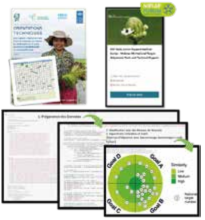
Morocco used two tools based on computer programming and artificial intelligence to analyse the alignment between the 26 national objectives of the Moroccan NBSAP and the 23 targets of the GBF, drawing on technical documents from UNDP, the GBF-EAS team, and CBD guidance to support this rapid analysis.
– Degree of similarity between the 23 GBF targets and the 26 objectives of the Moroccan NBSAP
The similarity score between the 23 GBF targets and the 26 objectives of the Moroccan NBSAP generally does not exceed 0.5. Only four targets reach a similarity score of 0.5, namely Targets 6, 8, 17 and 23. Five targets show a similarity score below 0.4 (Targets 2, 7, 9, 14 and 19).
Among the 26 national biodiversity objectives (NBOs) of the Moroccan NBSAP, GBF Goal B has the highest number of similar objectives (16 NBOs), followed by Goal A (8 NBOs) and Goal C (4 NBOs). The smallest number of similar national objectives is observed under Goal D (3 NBOs).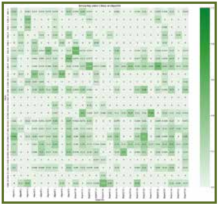
– Similarity heat map between the 23 GBF targets and the 26 NBSAP objectives
The heat map provides a visual overview highlighting the degree of similarity between the NBSAP objectives and the 23 targets of the Global Biodiversity Framework, illustrating their levels of interconnection. The analysis shows that each global target is linked to at least one national objective, with varying degrees of correspondence. However, among the 31 identified pairs, none shows high similarity; 48% display medium similarity and 52% low similarity. These results indicate that national objectives remain insufficiently aligned with the new GBF, justifying the need for their reformulation.
1.2 Whole-of-society and whole-of-government approach
To assess coherence between national biodiversity objectives and the GBF targets, Morocco adopted a whole-of-government and whole-of-society approach, in line with COP decision 15/4 and UNDP guidance. This approach, based on the coordinated mobilization of all levels of governance and societal actors (public administrations, local communities, civil society, the private sector, youth and women), ensured an inclusive and consultative process.
Throughout the process, this approach was fully applied, both during the analysis of the existing NBSAP and during the revision, alignment and reformulation phases of the new national biodiversity targets.
1.3 Reformulation of new National Biodiversity Targets (NBTs) aligned with the Kunming–Montreal Global Biodiversity Framework
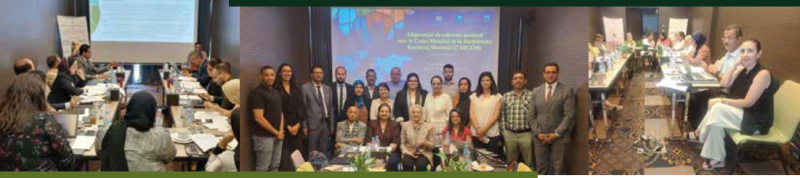
Discussions conducted through 27 bilateral meetings, collaborative working sessions (12 focus groups), and in-person and online meetings with the National Biodiversity Sub-Commission led to the reformulation of 25 National Biodiversity Targets (NBTs) aligned with the GBF for the 2035 horizon, in coherence with international commitments and national priorities, notably the New Development Model (NDM) and the National Sustainable Development Strategy (NSDS).
These targets are accompanied by a monitoring indicator matrix (flagship, binary, complementary and national indicators) to assess the implementation of the NBSAP-2035.
The 25 NBTs were adopted on 25 July 2024 during the meeting of the National Commission on Climate Change and Biodiversity, chaired by Ms. Leila Benali, Minister of Energy Transition and Sustainable Development, marking a major strategic milestone and reaffirming Morocco’s commitment to sustainable development and biodiversity conservation.
Outputs under Component 2: Assessment of monitoring systems
The assessment of national biodiversity-related monitoring systems revealed major gaps, characterized by heterogeneous, weakly harmonized and poorly interoperable data, insufficiently aligned with the GBF, despite the existence of several platforms (SINEDD, SIREDD, CHM, SNIS-HCP, NSDS).
In response, a strengthening plan was developed, including:
- a list of already adopted indicators;
- consideration of SINEDD (National Information System for Environment and Sustainable Development) and SIREDDs (Regional Information Systems for Environment and Sustainable Development) as potential data-collection bases, subject to upgrading;
- the creation of a national system dedicated to monitoring the future NBSAP (SysNBSAP) interconnected with existing platforms;
- a capacity-building programme, supported by a governance framework involving both the National Biodiversity Sub-Commission and territorial representatives.
Outputs under Component 3: Alignment and review of policies and institutions with the GBF
Under Component 3, the analysis of public policies highlights the need to strengthen the effective integration of biodiversity into national policies, plans and programmes through an inclusive and participatory whole-of-society approach.
The review of alignment between national policies and GBF objectives shows that, despite a generally solid strategic and legislative framework, implementation remains constrained by structural limitations. To address these gaps, it is recommended to:
- establish a binding political arbitration mechanism capable of integrating biodiversity into major sectoral decisions;
- finalize and enforce implementing decrees to make existing laws fully operational;
- improve budget allocation coherence by aligning public financing with biodiversity conservation and sustainable-use objectives;
- shift from a planning-based approach to a results-based approach grounded in accountability and effective impact monitoring.
Outputs under Component 4: Biodiversity financing activities
Activity 1: Analysis of the Policy and Institutional Context for Biodiversity Financing in Morocco (PIR)
Implementation of Component 4 enabled an analysis of Morocco’s biodiversity policy, institutional and financial framework using the BIOFIN methodology. The analysis highlights legal, institutional and policy gaps that limit the mobilization of sustainable financing for conservation, despite biodiversity’s strategic importance to the national economy.
Key recommendations are structured around four priority axes:
- Strengthening the legal framework, notably by integrating financing provisions into sectoral policies;
- Improving governance through enhanced coordination among stakeholders, particularly via the National Biodiversity Sub-Commission;
- Expanding and diversifying funding sources by mobilizing all available channels, including the private sector, while integrating green budgeting, expenditure tracking and territorial authority engagement;
- Structuring innovative financing mechanisms, supported by a national roadmap jointly led by the Ministry of Economy and Finance (MEF) and the Ministry of Energy Transition and Sustainable Development (MTEDD).
Activity 2: Analysis of Biodiversity-Harmful Subsidies in Morocco (BHS)
In line with the BIOFIN methodology, the analysis of biodiversity-harmful subsidies identified and prioritized public expenditures generating negative impacts on ecosystems. It reveals the predominance of sectoral subsidies lacking environmental conditionalities, contributing to resource overexploitation, pollution and habitat degradation.
The analysis recommends a gradual and targeted reform of public support instruments—particularly those related to irrigation, fertilizer use and fisheries—through the integration of environmental conditionalities, redirection of support toward sustainable practices, strengthened transparency and expenditure tracking, improved intersectoral coordination, and integration of biodiversity into budget planning.
Activity 3: Biodiversity Expenditure Review (BER)
The Biodiversity Expenditure Review constitutes a key step in better understanding public and private financial flows dedicated to biodiversity.
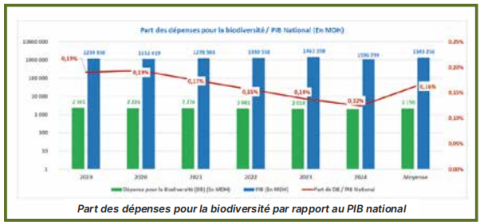
BER results indicate that public expenditures directly or indirectly related to biodiversity average approximately MAD 2.06 billion per year over the period studied, representing 0.16% of national GDP and between 0.34% and 0.89% of the State’s general budget. The budget trajectory shows a peak of over MAD 3 billion in 2019, followed by a gradual decline to MAD 1.36 billion in 2024, reflecting the fragility of biodiversity financing in a context where national budget priorities remain dominated by economic and social imperatives.
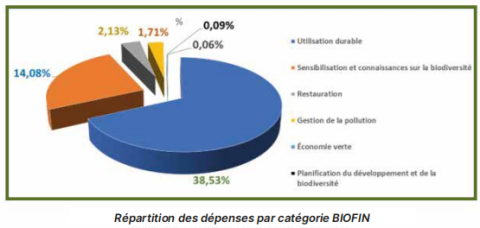
The analysis also highlights the distribution of expenditures across BIOFIN categories, with more than 96.33% concentrated in three major axes out of nine BIOFIN categories.
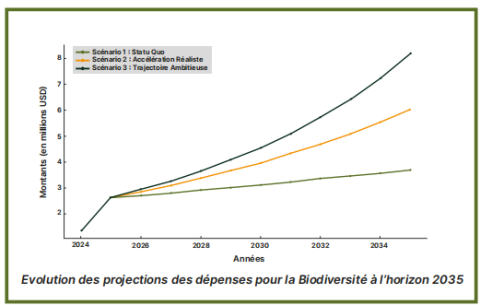
Based on the BER, three trend scenarios for biodiversity expenditure up to 2035 were identified:
- Status quo scenario: maintaining current effort at 0.16% of GDP, leading to limited growth from MAD 1.99 billion in 2024 to around MAD 3.7 billion in 2035;
- Realistic acceleration scenario: gradual increase to 0.27% of GDP, reaching approximately MAD 6 billion per year by 2035, subject to improved integration of biodiversity into public policies;
- Ambitious convergence scenario: targeting 0.33% of GDP by 2035, close to two-thirds of the international target, with annual expenditures estimated between MAD 8.2 and 8.6 billion, requiring structural budget reorientation and strengthened mobilization of public and private actors.
Building on the results of the PIR, BHS and BER, complementary BIOFIN activities—namely the Financing Needs Assessment (FNA) and the Biodiversity Finance Plan (BFP)—are planned under the next BIOFIN project.